A bank above the beach is a lovely thing to look at and a frustrating thing to plant. Salt arrives on the wind, grit scours anything soft, rain runs off before it soaks in, and the soil underneath is often thin, stony and poor. Anything lush and leafy is scorched by midsummer, bare patches open up, and the first gales of winter start moving topsoil downhill.
The answer is not to fight the site but to cover it. Low, mat-forming plants that evolved on cliffs, shingle and saltmarsh will knit the surface together, shade out weeds and shrug off spray. Once they are established, a slope that needed constant patching becomes something you barely have to think about.
Why coastal slopes are harder than they look
Three things do most of the damage. The first is salt: carried in wind, it burns leaf edges and draws moisture out of foliage. The second is drought. An exposed bank loses water from both sun and wind, and free-draining soil only makes it worse. The third is movement — wind rocking young plants loosens roots, and heavy rain on bare soil starts gullies that widen every season.
Then there is winter wet. Counter-intuitively, more coastal plants die of soggy roots at the bottom of a bank than of frost at the top. Aim for sharp drainage and a crown that sits clear of the soil surface, and you will lose far fewer plants.
What to look for in a plant
Before you buy anything, run candidates through a short list of traits. A plant that fails two or three of these will always be work.
- Low and spreading. Mat, cushion or creeping habits cover ground quickly and shelter their own roots.
- Small, leathery, waxy or hairy leaves. Thick or felted foliage holds water and resists salt burn.
- Evergreen where possible. Winter cover is when soil is most vulnerable.
- Genuine salt tolerance. Plants sold as "coastal" vary enormously; thrift, sea campion and sea heath are the real thing.
- Roots that hold. Fibrous, matting roots bind soil better than a single shallow taproot.
- Spreads without seeding everywhere. You want coverage, not a takeover.
The plants that earn their place
Mat-formers and creepers
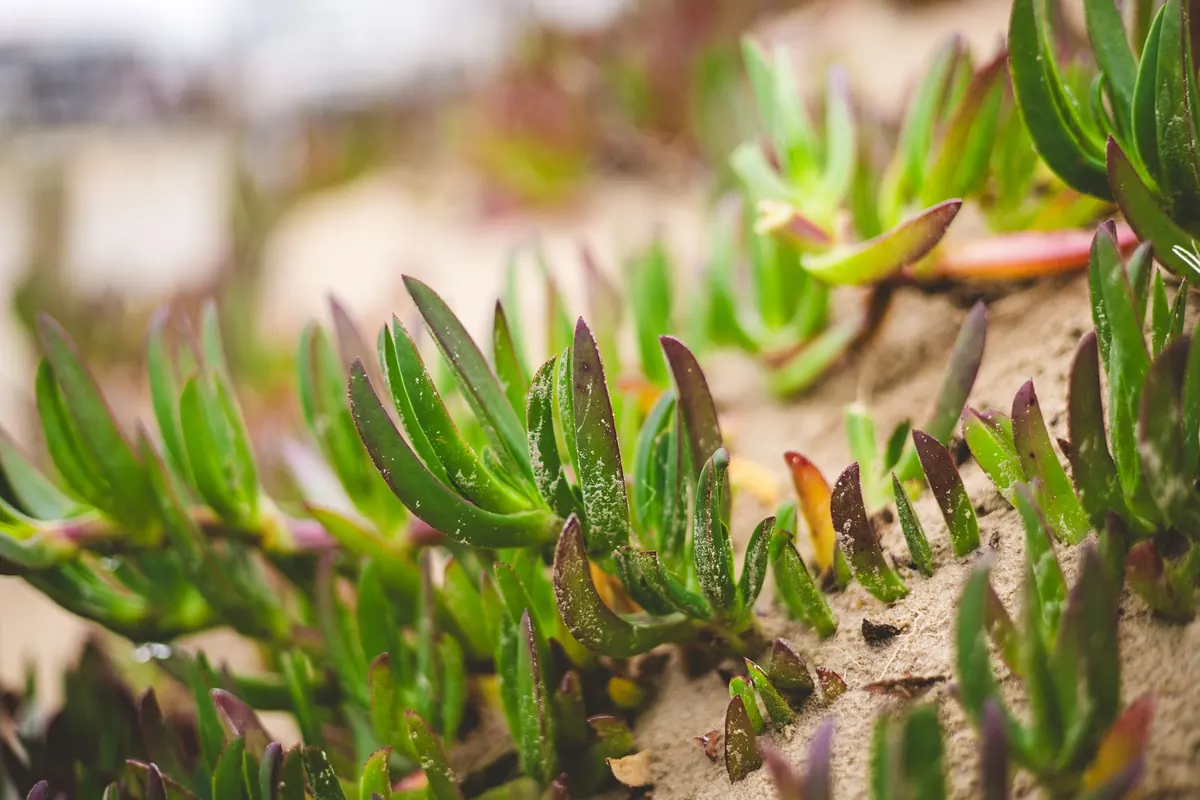
Thrift (Armeria maritima) is the classic: tight evergreen cushions, pink pom-pom flowers in late spring, and it grows happily where little else will. Sea campion (Silene uniflora) is its native companion, spreading into a loose grey-green mat with white flowers. Creeping thymes and stonecrops such as Sedum album and Sedum spurium are drought-proof and brilliant for pollinators, provided they get grit and sun. Beach aster (Erigeron glaucus) is worth seeking out for its grey foliage and long season of daisy flowers.
Silver and grey leaves
Silver foliage reflects light and copes with salt. Lamb's ears (Stachys byzantina) makes a soft carpet in full sun, cotton lavender (Santolina chamaecyparissus) stays neat and aromatic, and Hebe pinguifolia 'Pagei' forms a low, dense grey-green mat that is one of the best small shrubs for a windy bank. Snow-in-summer (Cerastium tomentosum) is dazzling in June but can flop in wet winters, so keep it high on the slope where water drains away.
Natives that knit the soil
Bird's-foot trefoil (Lotus corniculatus) and kidney vetch (Anthyllis vulneraria) are deep-rooted, nitrogen-fixing and excellent at holding a bank, with the bonus of yellow flowers for bees. Sea heath (Frankenia laevis) is a genuinely salt-proof evergreen carpet for milder, well-drained sites. Mix natives with the garden plants above: the natives do the engineering work, the others supply colour.
Planting a slope so it stays put
Technique matters more on a bank than anywhere else in the garden. Work through it in this order.
- Plant in spring or early autumn. Avoid midsummer heat and midwinter waterlogging, and never leave soil bare through the wettest months.
- Make pockets, not beds. Fork compost and grit into each individual planting hole rather than digging the whole slope. Every spit you turn on a steep bank is soil waiting to wash away.
- Angle the plant into the hill. Set it so it leans slightly uphill, with the crown just proud of the surface so water runs off the collar instead of sitting in it.
- Firm properly, then mulch with gravel. A 5cm layer of stone chip around each plant keeps the collar dry, suppresses weeds and stops rain scouring the surface. Keep it clear of stems.
- Use netting on the steepest banks. On a slope where soil visibly shifts after heavy rain, peg biodegradable jute or coir mesh over the surface and plant through it. It disappears as the plants close over.
- Space tightly. Around 30–45cm between mat-formers is close enough to merge within two seasons. Wide spacing just leaves room for weeds.
Getting weeds to lose the race
Weeds win on bare ground, so the strategy is simple: cover it. Plant densely, gravel-mulch between plants, and hand-weed for the first two seasons while the mats fill in. After that, a quick pass in spring and another in late summer is usually enough. Keep strimmers well away from cushions — a scalped thrift or hebe rarely recovers, and the bare patch that follows invites weed seed straight back in.
Skip the fertiliser. Rich, soft growth is exactly what salt wind and drought destroy, and it opens the centre of mats to rot. Poor soil suits these plants; leave it that way.
A light year of care
In spring, tidy away anything the winter killed and replant gaps straight away. In the first summer, water new plants thoroughly once a week during dry spells — a good soak rather than a daily sprinkle. Deadhead if you like, but leave seedheads for birds if you would rather not. In autumn, resist the urge to cut everything down; the old growth protects crowns from salt, cold and wind. Tidy properly in early spring instead, trimming back flowering stems but leaving the mat intact. Check netting and pegs after storms.
Starting on a steep bank: the order of work
Walk the slope before you buy a single plant. Note which way the prevailing wind hits it, where soil already collects, and where water sits after rain — those wet hollows need drainage, not more plants. Start at the top and work down, so you are not treading on newly planted ground. If the bank is very exposed, plant a small test patch first, see what survives a full winter, then repeat what worked.
Buy small plants and plenty of them rather than a few large specimens; they establish faster and cost less. Fix temporary mesh windbreak netting on the windward side for the first year if you can — a permeable screen, not a solid fence, which only creates damaging turbulence. Then keep the gravel topped up, keep the weeds down, and let the roots do the rest.
Photo: Rafael Rodrigues / Pexels