By the time a gale warning appears on the shipping forecast, the pots on a coastal plot are already the most exposed things in the garden. They sit high, they sit light, and the wind reaching them has crossed miles of open water, gathering speed and salt on the way. Inland gardens get wind. Coastal gardens get wind with an abrasive edge, arriving in gusts that shove rather than blow. Two or three hours of preparation before the front arrives will save a fortnight of clearing up and replanting.
What wind and salt actually do to a container
Wind causes damage in three ways. It pushes a pot over, it rocks a pot that stays upright, and it strips moisture from compost and leaves at a rate you will not see in a sheltered garden. Toppling is obvious: compost spills, stems snap, terracotta breaks, and a rolling pot can take out its neighbours on the way down.
Rocking is subtler and often worse. Every wobble tears fine roots away from the compost, so a plant can look untouched after a storm and then sulk for weeks. Salt is the third problem. Spray carried on the wind settles on leaves, draws water out through the leaf surface and leaves foliage scorched and brown at the edges, especially on evergreens, bay, rosemary and anything with soft new growth.
A pot on a balcony, roof terrace or sea-facing wall takes the worst of it. Wind accelerates around corners and over parapets, so the gust that reaches a sixth-floor terrace can be noticeably stronger than the one measured at ground level.
The pre-gale sweep: what to do a day ahead
Work through this list while the wind is still manageable. Doing it in daylight, in the calm before the front, is far easier than chasing a rolling pot in the dark.
- Check the forecast properly. Wind direction matters as much as speed. An onshore gale with salt spray is a different job from a dry offshore blow.
- Water everything thoroughly the day before. Damp compost is heavier, which helps stability, and it gives plants a reserve to draw on while salt is drying out their leaves.
- Empty saucers and trays. A full saucer catches wind like a sail and can flip a pot on its own.
- Move what you can. Small pots, seed trays, hanging baskets and anything in lightweight plastic should go into a shed, garage, porch or against a solid wall.
- Check stakes, ties and wall brackets. Replace frayed twine and any bracket that has started to pull away from the masonry.
- Take down hanging baskets and lay them on the ground in a sheltered spot, or lower them to a bench.
- Clear the area around pots. Move furniture, parasols, watering cans and bins that could be blown into them.
Move, weight or anchor: three ways to hold a pot down
Move it
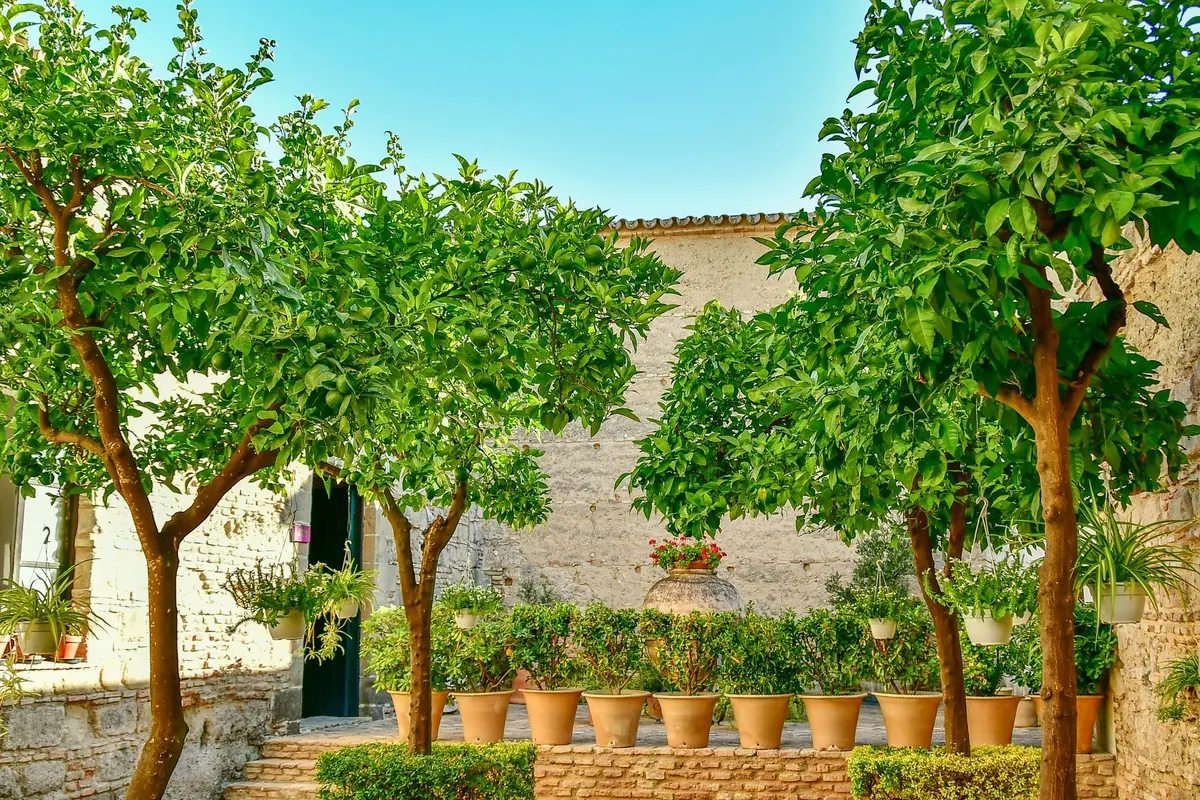
The best protection is a solid wall, ideally on the leeward side of the house. Group pots together in a huddle rather than spacing them out. A tight group shares the load and creates its own calm pocket in the middle.
Weight it
For pots you cannot shift, add weight low down. Slabs, bricks or paving stones placed on the compost surface work well on large planters, as long as they sit clear of the stems. Heavy pots with a wide base are far more stable than tall, narrow ones. If you have room, standing a pot inside a heavier outer container does the same job and hides the clutter.
Anchor it
Tall or top-heavy specimens, such as standard bays or olives, need more than weight. Use soft ties or webbing straps around the trunk or pot rim and run a guy line to a sturdy ground anchor, a heavy bench leg or a fixed post. Never tie to a railing, drainpipe or fence panel that could fail first and take the plant with it.
Tying down without harming the plant
The aim is to stop movement, not to strangle the stem. Use wide, soft material rather than thin wire or string, and run straps around the outside of the pot or around the trunk low down where the bark is thickest. Avoid tying directly under a leaf joint or across swelling buds. If you are strapping a trough to a bench, go over the whole container and under the bench rather than through the drainage holes, which can crack under load. Check every tie again halfway through the storm if you can do so safely, and never go outside during the worst of the gusts to adjust anything.
Shelter, grouping and windbreaks
Pots tucked tight against a south-facing wall will ride out most winter gales, but watch two traps. Wind accelerates around the corners of buildings, so the corner itself is often worse than the middle of the wall. And trees, especially fast-growing coastal species, can shed branches in high wind, so do not shelter pots directly beneath one.
If you use a windbreak, choose mesh or slatted material that lets some air through. A solid sheet simply becomes a sail and creates violent turbulence behind it. Group the heaviest pots on the windward edge of the cluster and the lightest in the middle.
The plants inside the pots
Tidy before the storm rather than pruning hard. Cutting stems now leaves open wounds and encourages soft regrowth that salt will burn straight back. Instead, stake anything tall, shorten long flower spikes on plants such as crocosmia, and move tender succulents and citrus under cover. Do not feed in the days before a gale; you want steady, hard growth, not a flush of soft shoots. Once the wind has passed and rain has washed the salt off the leaves, a thorough rinse with fresh water from a can or hose will help plants recover. Leave any pruned or browned foliage in place for a week or two so you can see what is genuinely dead.
Make it a routine, and keep a kit ready
Every coastal garden faces this several times each winter, so treat the preparations as a fixed routine rather than a scramble. Keep a box ready with soft ties, webbing straps, ground pegs, a couple of bricks or slabs, sharp secateurs and a torch. Store it where you can reach it quickly, and refill it after each storm. When a warning is issued, you want to be working through a familiar list, not searching the shed in the rain. A pot that is still standing, with its roots intact and its leaves unburnt, is worth the hour it costs.
Photo: Nadiye Odabaşı / Pexels